
How to Choose an Interior Designer in Singapore: 10 Essential Questions to Ask for a Perfect Home Renovation
Your Blueprint for a Stress-Free Renovation
Starting a home renovation journey in Singapore is an exciting milestone. Whether you’ve just collected the keys to your new BTO flat, are planning a major overhaul of your existing HDB renovation, or are customizing a private condo space, the dream of a beautiful, functional home is within reach. However, the path from vision to reality is often complex, filled with regulatory hurdles, budget considerations, and critical design decisions.
This is where the right Interior Designer becomes your most valuable partner. Choosing the wrong one can lead to costly delays, budget overruns, and a final result that falls short of your expectations. Your choice of ID is arguably the single most important decision you will make in the entire process.
To help you navigate this crucial selection process, we have compiled the 10 essential questions across 3 sections you must ask every potential Singaporean interior design firm. These questions are specifically tailored to the unique challenges and opportunities of the local property landscape, ensuring you find a professional who is not only talented but also compliant and perfectly aligned with your personal style.
Ready to transform your space with confidence? Let’s dive into the questions that will unlock your perfect partnership.
Section 1: The Foundation – Understanding Your Needs
Before you even begin interviewing potential IDs, you must lay the groundwork. A successful renovation is a collaboration, and the better prepared you are, the more efficient and accurate your ID’s proposal will be.
Why Preparation is Key Before Meeting Any ID
The first step in choosing an Interior Designer in Singapore is understanding your own needs and constraints. This preparation phase is crucial for filtering out unsuitable firms and ensuring you get a precise quote.
- Define Your Budget and Timeline: Be realistic about how much you can spend and when you need to move in. A good ID will respect your budget; a great ID will help you allocate it wisely.
- Gather Inspiration and Define Your Style: Create a mood board. Use platforms like Pinterest or Houzz to collect images of rooms, furniture, and materials you love. This visual guide is far more effective than trying to describe your aesthetic verbally.
Know Your Home Type and Constraints
In Singapore, the type of property dictates the rules of your HDB renovation.
HDB/BTO: You must adhere to strict HDB guidelines regarding hacking, wet works, and window replacements. Your ID must be familiar with these rules and the necessary permit application process.
Condo: While generally less restrictive than HDB, condos have their own management corporation (MCST) rules regarding working hours, noise levels, and the types of renovations allowed.
Landed Property: Offers the most freedom, but still requires compliance with BCA (Building and Construction Authority) regulations for structural changes.
By doing this homework, you demonstrate that you are a serious client, which in turn attracts serious, professional Singapore interior design firms.
Section 2: The 10 Essential Questions to Ask Your Interior Designer
These ten questions move beyond surface-level discussions and delve into the practical, financial, and regulatory aspects of your renovation. Use them as your checklist to vet every potential renovation contractor or ID firm.
Key Focus: Local expertise, compliance, and proven track record.
In Singapore, experience with the specific property type you own is non-negotiable. An ID who specializes in landed properties may not be the best fit for a compact HDB renovation, where space planning and regulatory compliance are paramount.
What to look for in the answer:
Specific Numbers: Ask how many projects of your property type (e.g., 4-room BTO, 3-bedroom condo) they have completed in the last two years.
Regulatory Knowledge: They should be able to immediately discuss the key constraints of your property, such as the 5-year Minimum Occupation Period (MOP) for BTOs, or the specific walls that cannot be hacked in an HDB flat.
Portfolio Relevance: The portfolio should showcase projects that are similar in size and scope to yours, not just their largest, most expensive jobs.
SG Insight: For BTO owners, the ID must be intimately familiar with the HDB’s renovation permit application process and the list of approved works. This knowledge prevents costly stop-work orders and ensures your renovation is compliant from day one.
Key Focus: Design philosophy, company expertise, and creative alignment.
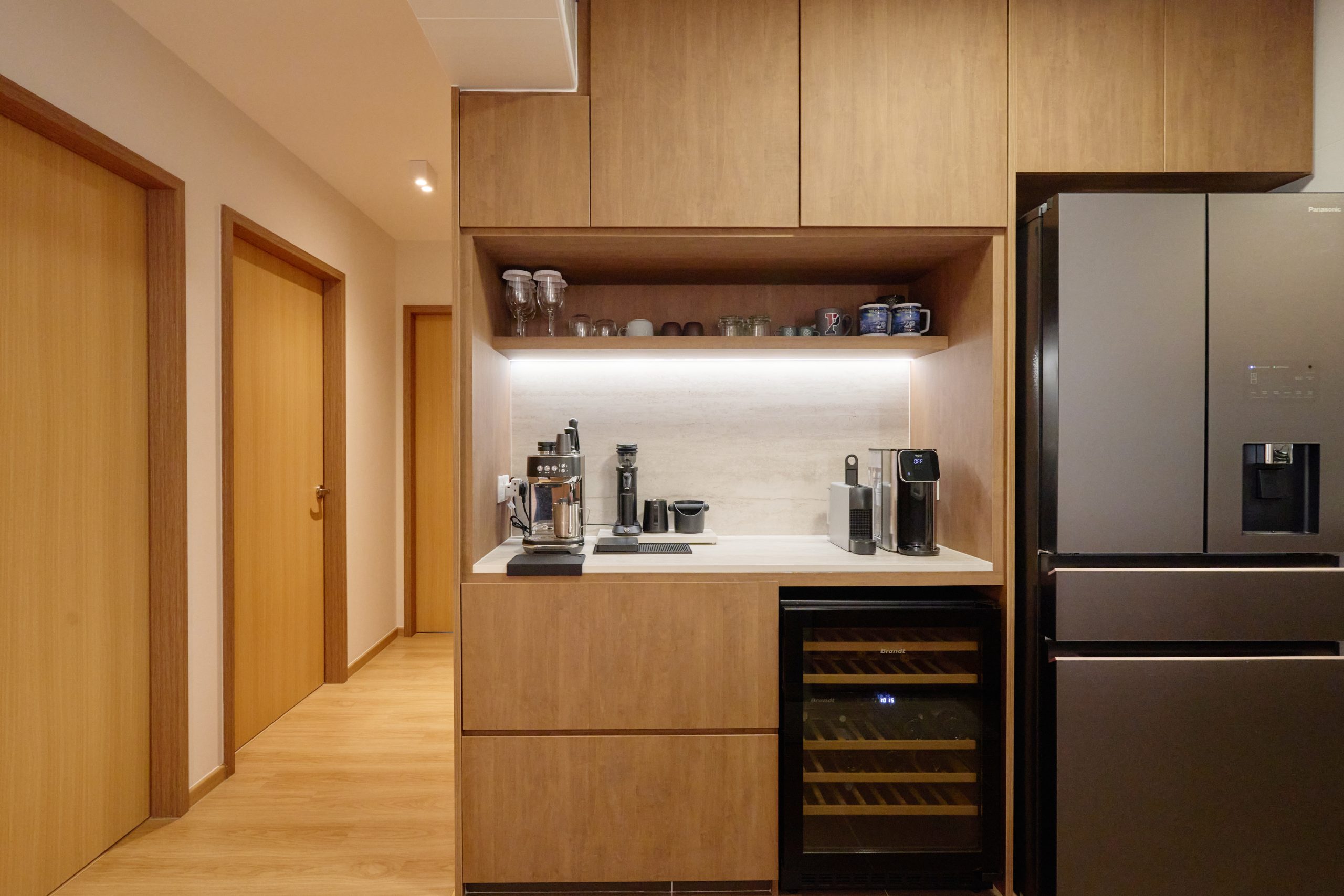
This question is your opportunity to gauge the ID’s creative depth and, specifically, to see how they align with Interior Diary’s unique selling proposition. At Interior Diary, we pride ourselves on our mastery of the Japandi and Wabi-sabi aesthetics—styles that are perfectly suited for the modern Singaporean home.
What to look for in the answer:
Japandi: They should talk about the fusion of Japanese minimalism and Scandinavian functionality. Look for keywords like natural materials (light wood, rattan), clean lines, and a neutral, calming colour palette.
Wabi-sabi: This is a deeper philosophy. The ID should discuss finding beauty in imperfection, embracing authenticity, and using textures like raw concrete, linen, and aged wood to create a sense of tranquil, lived-in elegance.
Adaptation: For smaller HDB flats, the ID should explain how these styles, which prioritize open space and light, can be used to make the home feel larger and more serene, often through clever built-in storage and multi-functional furniture.
Interior Diary Expertise: Our IDs specialize in translating the tranquil, uncluttered principles of Japandi and Wabi-sabi into practical, space-saving solutions for Singapore interior design. We believe your home should be a sanctuary, and these styles allow us to create a timeless, peaceful retreat from the city bustle.
Key Focus: Transparency, budget management, and avoiding hidden costs.
Renovation costs are a leading cause of stress. A professional ID will provide a clear, itemized quotation that leaves no room for ambiguity.
What to look for in the answer:
Itemized Breakdown: The quote should separate design fees (if any), project management fees, and the cost of the actual construction/materials.
Exclusions: Pay close attention to what is not included. Does the quote cover lighting fixtures, appliances, or loose furniture? Are there provisional sums for unexpected works?
Payment Milestones: A clear payment schedule tied to project completion stages (e.g., 10% upon signing, 30% upon commencement of hacking, 30% upon completion of carpentry, 30% upon handover) protects both parties.
Pro Tip: Be wary of quotes that are significantly lower than the market average. They often rely on low-quality materials or will hit you with numerous variation orders (V.O.s) later in the process.
Key Focus: Project management, accountability, and client relationship.
You need to know who is responsible for your project and how accessible they will be. Will you be dealing with the principal designer, a project manager, or a rotating team member?
What to look for in the answer:
Single Point of Contact: Ideally, you should have one dedicated person, your ID or a dedicated project manager, who oversees everything and is your primary contact.
Communication Frequency: Establish expectations for updates. Will they be daily, weekly, or only when a major milestone is reached? How will they communicate (WhatsApp, email, site meetings)?
Site Visits: Ask how often the ID or project manager will be on-site to supervise the renovation contractor and workers. Regular supervision is vital for quality control.
Key Focus: Realistic expectations, scheduling, and regulatory compliance.
A detailed timeline is a sign of a well-organized firm. It should account for all phases, from design conceptualization to final handover.
What to look for in the answer:
Phased Schedule: The timeline should include distinct phases: Design & Conceptualization, Permit Application (critical for HDB renovation), Material Sourcing, Hacking & Demolition, Wet Works, Electrical & Plumbing, Carpentry Installation, and Final Touch-ups.
Permit Buffer: The ID should factor in time for HDB or MCST approval, which can take several weeks. They should handle the submission of necessary documents, including the list of works and the contractor’s details.
Contingency: A professional ID will build in a buffer for unforeseen delays (e.g., material shipping delays, unexpected site issues).
| Phase | Estimated Duration (Example) | Key Milestone |
| Design & Contract | 2-4 Weeks | Contract Signed, 3D Renderings Approved |
| Permit Application | 1-3 Weeks | HDB/MCST Approval Granted |
| Hacking & Demolition | 1 Week | Site Cleared |
| Wet Works & Tiling | 3-4 Weeks | Tiling Completed |
| Carpentry Fabrication & Installation | 4-6 Weeks | Built-in Furniture Installed |
| Final Touch-ups & Handover | 1 Week | Final Inspection & Key Handover |
Key Focus: Quality control, reliability, and ethical sourcing.
The ID is only as good as the tradespeople they employ. You are hiring the ID to manage the entire supply chain and workforce.
What to look for in the answer:
Trusted Network: Do they work with a regular team of renovation contractor partners, or do they tender out every job? A long-standing relationship often translates to better quality and reliability.
Material Sourcing: How do they select materials? If you are interested in Japandi or Wabi-sabi design, they should be able to source high-quality, sustainable, and natural materials like solid wood, textured plaster, and stone.
Supervision: Reiterate the supervision process. You want assurance that the ID is actively managing the quality of work being done by the sub-contractors.
Key Focus: Accountability, peace of mind, and long-term support.
Even the best renovations can have minor issues emerge months after completion. A strong warranty is a sign of a firm that stands behind its work.
What to look for in the answer:
Warranty Duration: The industry standard for workmanship is typically 6 to 12 months. Ask for this in writing.
Coverage: What exactly does the warranty cover (e.g., carpentry defects, peeling paint, plumbing leaks)?
Rectification Process: What is the procedure for reporting a defect, and what is the guaranteed response time for rectification?
Key Focus: Flexibility, contingency planning, and change management.
Changes are inevitable in any renovation. The key is how the ID manages them to minimize financial and timeline impact.
What to look for in the answer:
Variation Order (V.O.) Protocol: A clear, documented process for V.O.s is essential. No work should proceed on a change until you have signed off on the revised cost and timeline.
Contingency Fund: A good ID will advise you to set aside a contingency fund (typically 10-15% of the total budget) for unforeseen issues, especially in older HDB renovation projects where hidden pipe or wiring issues are common.
Cost-Saving Alternatives: If a change pushes the budget, the ID should proactively suggest cost-saving alternatives in other areas to keep the project on track.
Key Focus: Practicality, space planning, and understanding the Singaporean lifestyle.
Space is a premium in Singapore. Your ID must be a master of spatial efficiency.
What to look for in the answer:
Smart Storage Solutions: They should discuss creative ways to incorporate storage without sacrificing aesthetics—think hidden storage under platforms, integrated cabinetry, and multi-functional furniture.
Ergonomics and Flow: Ask them to explain how they plan the “flow” of the home. For example, how they would use lighting and materials to visually expand a small living area, or how they would design a kitchen to maximize counter space.
Lifestyle Integration: The design should reflect your daily habits. If you work from home, they should prioritize a dedicated workspace. If you host often, they should focus on flexible dining and living areas.
Interior Diary’s Approach to Space: Our Japandi and Wabi-sabi designs naturally lend themselves to maximizing space. By focusing on essential, high-quality pieces and eliminating clutter, we create an illusion of spaciousness and tranquility, making even the most compact BTO flat feel expansive and serene.
Key Focus: Credibility, references, and independent verification.
This is the ultimate test of an ID’s reliability. Testimonials on a website are good, but speaking directly to a past client is invaluable.
What to look for in the answer:
Willingness to Provide Contacts: A confident, reputable firm will happily provide references. If they hesitate, consider it a red flag.
Specific Feedback: When you speak to the reference, ask about the ID’s communication, adherence to the budget and timeline, and how they handled any problems that arose.
Project Similarity: Ensure the references are for projects similar to yours (e.g., another HDB renovation or a condo project with a similar budget).
Section 3: Beyond the Questions – The X-Factor
While the 10 questions cover the technical and financial aspects, the success of your renovation also hinges on the intangible, the human element.
The Importance of Chemistry and Trust

The ID-client relationship is a partnership that can last anywhere from three to twelve months. You will be sharing personal details about your lifestyle, budget, and family needs.
- Trust Your Gut: Do you feel comfortable with the ID? Do they listen more than they talk? Do they seem genuinely excited about your project? A good ID is a great listener who can translate your vague ideas into concrete designs.
- Shared Vision: The ID should be able to articulate your vision back to you. If you feel like they are pushing their own agenda or ignoring your core requirements, they are not the right fit, no matter how impressive their portfolio.
Why Interior Diary is the Right Choice for Your Singapore Home

At Interior Diary, we don’t just renovate homes; we craft sanctuaries. Our commitment to excellence is built on three pillars that directly address the concerns of the discerning Singaporean homeowner:
- Local Regulatory Mastery: We have extensive, proven experience with HDB renovation, BTO, and condo regulations. We handle all permit applications and ensure every aspect of your project is compliant, giving you complete peace of mind.
- Design Specialization: Our deep expertise in Japandi and Wabi-sabi design allows us to create homes that are not only stunning but also inherently functional and calming. We use these principles to maximize the limited space often found in Singapore properties, focusing on natural light, clean aesthetics, and clever storage.
- Transparent Partnership: We believe in absolute transparency. Our quotes are detailed, our communication is proactive, and we treat your budget as if it were our own. We are not just a renovation contractor; we are your dedicated design partner.
Your Dream Home Awaits

Choosing an Interior Designer in Singapore is a significant decision, but with the right preparation and the 10 essential questions in hand, you are equipped to make an informed choice. Remember that the best ID will offer a blend of creative talent, technical expertise, and a deep understanding of the local regulatory environment.
Your journey to a beautiful, tranquil, and compliant home starts now. Don’t settle for anything less than a perfect partnership.
Ready to discuss your vision for a Japandi or Wabi-sabi inspired sanctuary?
Book an Appointment with Interior Diary Today! (click on the whatsapp button below)
Keen to learn more?
We have guides on condo renovation, HDB renovation and even guides on specific rooms in the house.